

Home » Il blog di mattoncini compatibili » Senza categoria » Children’s cognitive development through play
Cognitive development in children also (and especially) happens through play.
Few toys stimulate the mind like building bricks. A child stacking colorful pieces isn’t just playing: they’re reasoning, experimenting, making decisions. They’re exercising their brain as naturally as they laugh or marvel.
Every construction, every wobbly tower or imaginary castle, is a little mental gym: the child plans, tries, fails, corrects, and tries again.
Play becomes learning, and building is learning by doing.
Seymour Papert, a pioneer of modern education, understood this well when he talked about constructionism.
According to this theory, children truly learn only when they’re engaged in something that matters to them, like building a model, writing a story, or programming a robot.
The idea is simple: the more emotionally and actively involved a child is, the deeper they learn.
And what activity is more engaging than building something with their own hands, seeing the result, modifying it, and then starting over?
Another great truth: you can’t force a child to play with something that doesn’t excite them.
If a toy doesn’t work, you’ll know right away. But when it does… you’ll know even sooner: the child won’t want to stop.
About 27% of children still play with bricks inherited from parents or older siblings. And those parents almost always buy new ones. Because they know those little pieces do a lot: they entertain, unite, and develop the mind.
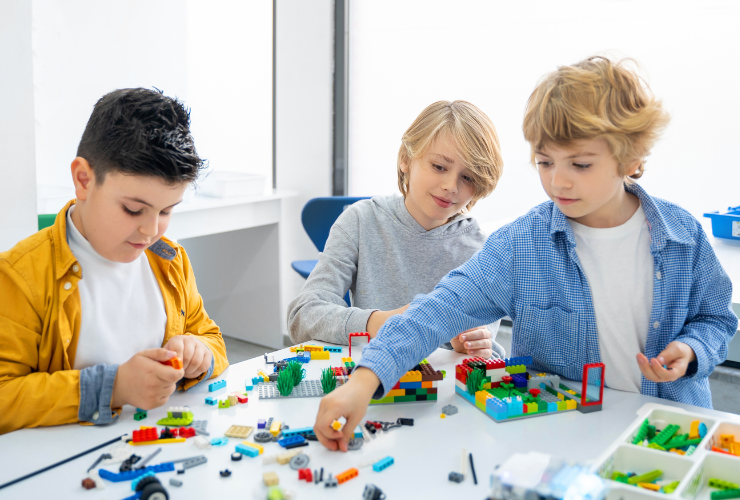
While building, a child develops logical, motor, narrative, and spatial skills. They’re creating stories, solving problems, making choices.
And they do it with joy, concentration, and a freedom that no worksheet could match.
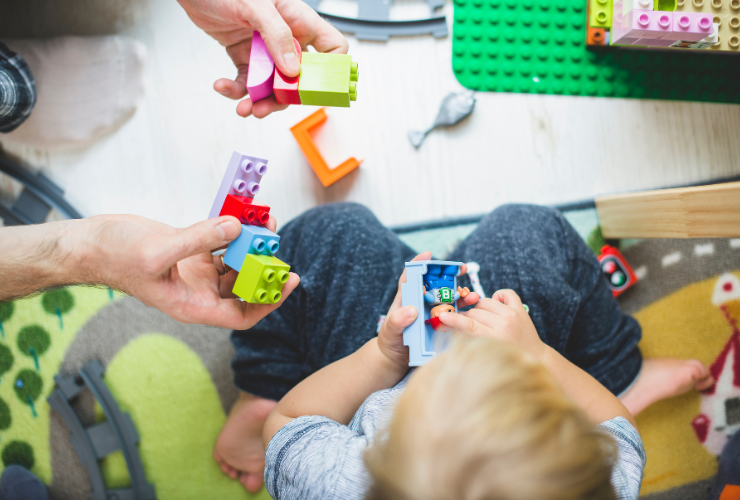
The beauty is that often even the adult ends up sitting next to them, partly to help and partly to become a child again.
Because, deep down, building frees the mind at any age.
Encouraging cognitive development doesn’t require complicated tools or futuristic technologies.
Sometimes all it takes are curious hands, a clear surface, and a handful of bricks.
That’s where great discoveries begin. That’s where thought, creativity, and the desire to learn are built.
Ciao! 🙂 Siamo Sean e Lee!
Hai qualche domanda?
Siamo qui per aiutarti!