
Senza categoria
Home » Il blog di mattoncini compatibili » Senza categoria » ADHD Games: Building blocks that help you grow
When it comes to ADHD games, one of the most effective and underrated tools is the building blocks that are helping many families turn play into a tool for growth and well-being.
Yes, you heard that right: we’re talking about the classic building blocks, the ones you might have used as a child.
Not just a creative pastime, but a true therapeutic ally to improve attention, self-control, and social skills.
Why do ADHD games really work?
Children with Attention Deficit Hyperactivity Disorder face a real challenge every day: staying focused, managing energy, respecting time and rules. This often puts them at a disadvantage in group games, sports activities, or even just in relationships with others.
Building blocks offer a wonderful alternative because:
-
They naturally capture attention,
-
They require following precise steps,
-
They develop patience and coordination,
-
They encourage collaboration with others,
-
They help manage emotions.
All this… while playing!
Not just play, but social growth
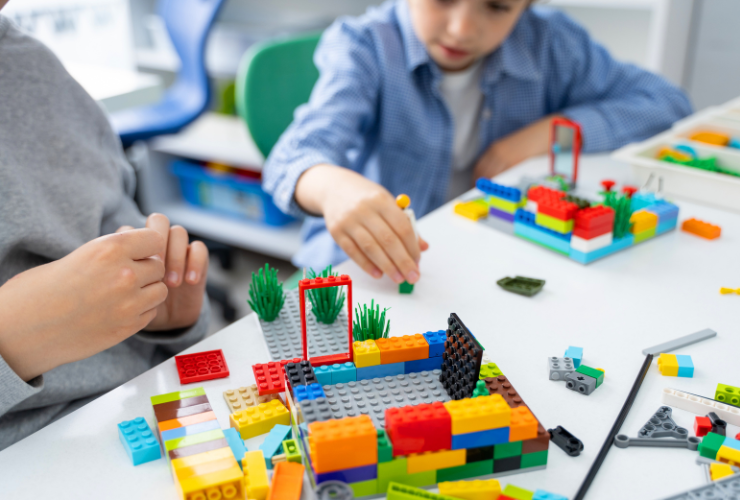
One of the most beautiful aspects is that these games allow you to team up.
In therapy, work is often done in small groups. Each child has a role: someone reads the instructions, someone finds the pieces, someone assembles them.
This simple dynamic teaches taking turns and listening to others, learning the meaning of waiting and patience, but also working together towards a common goal, improving the spirit of collaboration.
And the surprising thing is that children don’t see it as an exercise or therapy, but as a moment of pure fun.
ADHD games to prepare for success… one block at a time
You don’t start with difficult projects right away. The journey begins with simple activities, tailored for each child. Work is done on:
-
Recognizing shapes and colors,
-
Finding and matching similar pieces,
-
Following small visual instructions,
-
Copying constructions from an adult or a peer.
Every small achievement is valued and rewarded, helping the child believe in their abilities.
From first steps to more complex constructions
As the child gains confidence, they move on to bigger challenges. Sets with more pieces, more elaborate projects… but always respecting their pace and abilities.
A trick that works? Start with a set that’s already partially built, leaving the child to complete it.
This motivates them greatly, as it immediately shows them the final result and makes them feel proud of themselves.
In fact, the journey usually begins with the proposal of a small set that reflects the child’s interests, thus promoting intrinsic motivation. The initial goal is not perfection, but active participation and the completion of simple tasks that help build confidence in one’s abilities.
The crucial role of those who accompany the child
Behind every success, there’s always an adult who supports and encourages. The therapist, first of all, but also parents can continue the work started in therapy at home.
How? It’s simple:
-
By proposing small construction projects together,
-
Respecting the child’s pace and limits,
-
Experiencing the game as a moment of connection, without pressure.
What to avoid to not undermine progress
Be careful, though: not all children are the same.
It’s important to remember that every child is unique, with their own pace, sensitivities, and personal challenges.
What works for one may not work for another. For this reason, participation in activities with building blocks should always be voluntary and never imposed.
A child who feels forced risks associating the activity with a source of anxiety or frustration, nullifying all the benefits that play can offer.
Proposing alternatives
For this reason, it’s useful to always offer alternatives. Not all children feel ready to participate in a group, and that’s perfectly fine. Some need more time, a personalized path, or simply to start with individual activities before moving on to collaborative building. Offering different choices allows the child to feel safe and respected, increasing their motivation over time.
Making the group homogeneous
Another mistake to avoid is mixing children with too different needs and difficulties. For example, putting children who struggle with hyperactivity and others who suffer from anxiety or communication blocks in the same group can create unbalanced dynamics. The former risk becoming too intrusive or dominant, while the latter may feel overwhelmed and withdraw even more.
For this reason, it’s advisable to create homogeneous groups by age and characteristics, where each child can feel comfortable and part of a small team that shares similar challenges. This way, a climate of collaboration and mutual understanding is fostered, avoiding situations that could fuel frustration or make someone feel excluded or inadequate.
Synergy among adults
Managing the adults involved also requires attention. Parents, educators, and therapists must work in synergy, avoiding burdening the child with expectations or excessive pressure. It’s essential to celebrate every small progress, without chasing perfect performance. The goal is not to “build the most beautiful set,” but to help the child grow at their own pace, valuing every milestone achieved.
In summary, to make this journey with ADHD games truly effective, it’s essential that everything is experienced as a positive, serene, and personalized experience, where the child feels free to experiment, make mistakes, improve, and, above all, have fun.
ADHD Games: Ready to face every challenge!
ADHD games with building blocks don’t work magic, but they can truly change the way your child faces everyday challenges.
-
More attention,
-
More self-control,
-
More ability to work in a group,
-
More self-confidence.
All this through play, without stress and without pressure.
Because every block put in the right place is not just a piece of plastic but a step towards serene and happy growth.