
Senza categoria
Home » Il blog di mattoncini compatibili » Senza categoria » Games for autistic children: the power of building bricks
When talking about games for autistic children, it’s not just about pastime and fun. Play can become a powerful tool for communication, growth, learning, and socialization.
Among the most effective activities in this area are those related to building bricks, which combine creativity and structure, freedom and rules, free play and shared goals.
Building bricks: among the best games for autistic children
Bricks are an extraordinary means to support children on the autism spectrum, especially when used in guided or semi-structured contexts.
It’s not just about assembling pieces, but about building skills. The benefits extend to various areas:
-
Cognitive: development of logical thinking, problem-solving, and attention to detail;
-
Motor: improvement of fine motor skills through precise manipulation;
-
Social: promotion of collaboration, turn-taking, and communication, both verbal and non-verbal;
-
Emotional: managing frustration, boosting self-esteem, and a sense of accomplishment.
Why do they work?
Because bricks speak the language of autism: they are predictable, structured objects, manipulable with hands.
They offer a reassuring boundary while also stimulating creativity. Moreover, they can be used both individually and in groups, adapting to the child’s comfort level and needs.
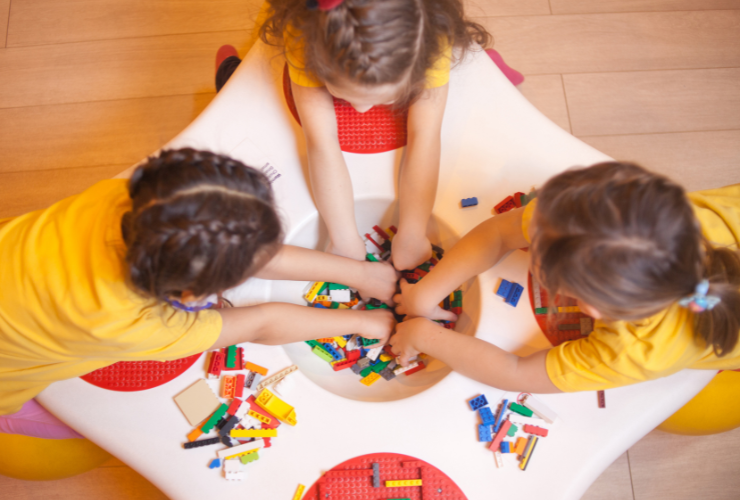
In the most advanced therapeutic paths, bricks are not used randomly. Children do not build alone, but work in pairs or small groups, each with a specific role:
-
The engineer reads the instructions and guides the project;
-
The supplier finds the necessary pieces;
-
The builder assembles the pieces.
This dynamic requires and stimulates the use of language, social understanding, peer coordination, and conflict resolution. Even non-verbal children can participate, communicating with gestures, looks, and unconventional strategies.
Who can guide these activities?
Brick activities are even more effective when guided by qualified figures: psychologists, educators, occupational therapists, or professionals with experience in neurodevelopment and social communication. It’s important that participant selection is done carefully, avoiding overly heterogeneous groups that could cause frustration. Generally, a well-balanced group consists of 6 children with two adult supervisors.
A program recognized internationally
A concrete example of effectiveness is the Brick-by-Brick project, born from the work of the Play Included foundation in collaboration with the clinical and educational world. This approach has achieved significant results in improving social skills, cognitive flexibility, and the participation of children with autism in group settings.
As highlighted by the Autism for All Project portal, structured games (like those with bricks) are particularly suitable for non-verbal children, as they promote gestural and symbolic communication, as well as increase engagement and attention span.
Games for autistic children: not just therapy, but also joy
While the therapeutic aspect is central, we must not forget the joy of play.
Bricks give children the chance to create, destroy, retry, innovate. The freedom to explore, even just to fit two pieces together, can provide a sense of mastery and control that many children on the spectrum seek.
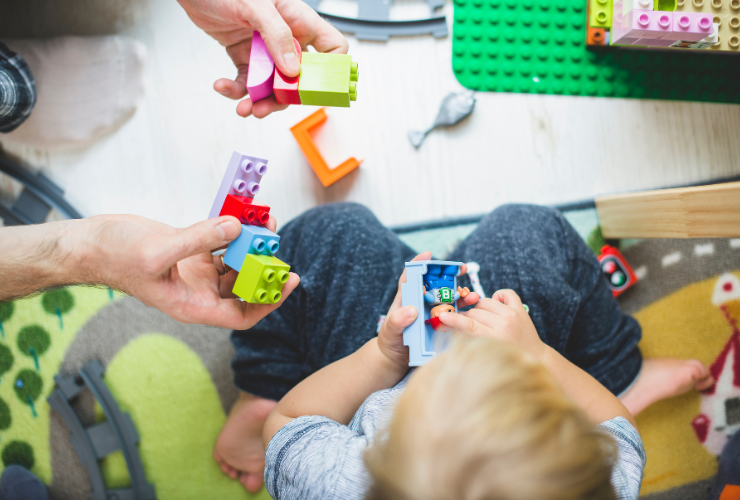
And for parents? These games also offer an opportunity for family sharing: building together means observing, dialoguing, celebrating small successes. A tower built together can become an emotional bridge, a story to tell, a moment of genuine connection.
Bricks to build your own future
Building bricks are not just a game: they are inclusive, flexible, educational, and therapeutic tools.
Among the best games for autistic children, they stand out for their ability to combine learning and fun, logic and imagination, structure and freedom.
Whether at home, in therapy, or in a dedicated club, building is a simple gesture that can generate great transformations.